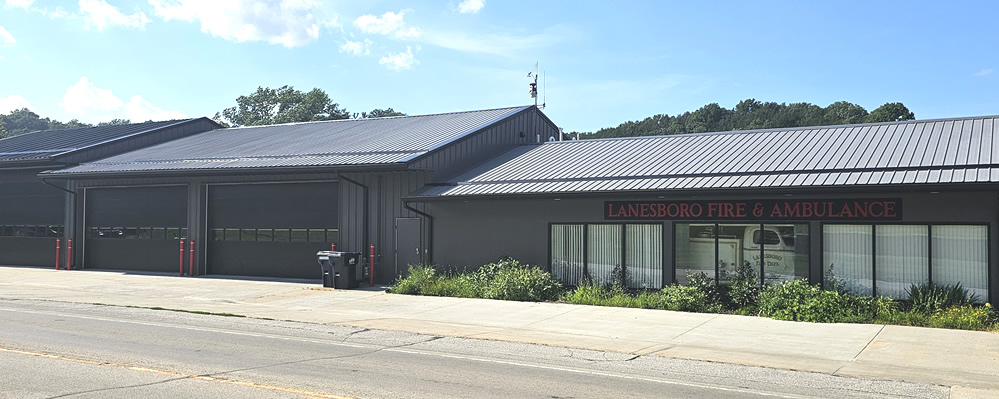
Emergency Services

For Emergencies – Call 911
Be Prepared to Provide:
Be Prepared
Weather Emergencies
- The Fillmore County Sheriff’s Department, Preston Police Department, and Lanesboro Fire Department will work together to attempt to notify affected persons, including any necessary evacuations.
- If weather events require shelter, the Community Center Building lower-level locker rooms are open 24 hours a day 7 days a week. Authorities may also open additional space in the Community Center as necessary.
- Should wind speeds be observed over 70mph, the siren will be sounded to notify residents to take shelter. Both Fillmore County Sheriff’s department and the Lanesboro Fire Department have the ability to sound the siren should the need arise.
- Weather Emergency Resources
Bike Trail Safety Tips
- Wear a helmet every time you ride.
- Stay alert and watch for other cyclists, pedestrians, runners, pets, and obstacles.
- Follow posted signs and trail rules, including speed limits and designated directions of travel.
- Slow down when approaching curves, intersections, bridges, and crowded areas.
- Give an audible warning when passing others, such as saying “On your left.”
- Keep a safe distance from other trail users.
- Control your speed so you can stop quickly if necessary.
- Use lights and reflective gear when riding in low-light conditions.
- Check your bike before riding, including brakes, tires, chain, and handlebars.
- Stay on the designated trail and avoid riding on areas that are closed or unsafe.
- Be cautious around wet leaves, gravel, mud, sand, ice, and other slippery surfaces.
- Do not use your phone or other distractions while riding.
- Avoid wearing headphones that prevent you from hearing cyclists or other hazards.
- Keep pets under control and follow trail rules regarding leashes.
- Carry water and basic supplies, especially on longer rides.
- Let someone know where you are going if you’re riding alone or on a remote section of trail.
- Watch the weather and avoid riding during severe storms or dangerous conditions.
- Respect other trail users and share the trail courteously.
- Be especially careful at road crossings—stop, look both ways, and follow crossing signals.
- Know your limits and choose a speed and route appropriate for your experience and fitness level.
River Safety Tips
- Always wear a properly fitted life jacket (PFD) while on the river—even if you are a strong swimmer.
- Check the weather and river conditions before heading out. Avoid the river during severe weather or dangerous water levels.
- Know the river route and be aware of hazards, including rapids, rocks, fallen trees, dams, bridges, and low-head dams.
- Never underestimate moving water. River currents can be much stronger than they appear.
- Stay with your group and avoid traveling alone.
- Tell someone your plans, including where you are putting in and taking out and approximately when you expect to return.
- Use the right equipment for the river conditions and make sure your canoe, kayak, or tube is in good condition.
- Secure your equipment so paddles, coolers, and other items don’t become hazards if you capsize.
- Avoid alcohol and drugs
- Keep a safe distance from dams and other dangerous structures. Never attempt to go over or around.
- Watch for changing water conditions and be prepared to get off the river if conditions become unsafe.
- Keep children within close reach and supervision at all times.
- Dress for the water temperature, not just the air temperature.
- Carry essential safety equipment, such as a whistle, phone in a waterproof case, and basic first-aid supplies.
- Know what to do if you capsize. Stay calm, keep your PFD on, and stay with your boat when possible.
- Never tie tubes, canoes, or kayaks together in a way that could make it difficult to maneuver or separate in an emergency.
- Do not enter the river if you are unsure about the conditions. It is always better to postpone a trip than risk an accident.

202 Parkway Ave S
Lanesboro, MN 55949
Lanesboro, MN 55949
Monday-Friday
8am-12pm | 12:30pm-3pm